Aajwanthi, Priyanka and I gave a presentation to the 2nd, 3rd and 4th years students who were participating in the Index Design Challenge. We spoke about Design in Education, Alternative Learning Methods, and our respective diploma projects in the realm of Design and Learning.
Showing posts with label Research. Show all posts
Showing posts with label Research. Show all posts
Monday, August 16, 2010

Thursday, August 12, 2010
Interesting visual styles and formats
Installation:

 5 sided LCD display:

Multi-touch interactive surfaces:


Paper explorations:

Interactive video installations:

(I will keep adding to this post as and when I find something interesting)


Multi-touch interactive surfaces:


Paper explorations:

Interactive video installations:

(I will keep adding to this post as and when I find something interesting)
Tuesday, August 10, 2010
Saturday, August 7, 2010
Siftables- The toy blocks that think
Toys that inspire learning, innovation — and of course fun! These are the toys of the technological age: they are alive, they think, they perform magic. What were your favorite toys as a kid (or an adult), and what did they inspire in you? David Merrill replaces traditional building blocks with electronic tiles that can add, subtract, compose and create.
Siftables aims to enable people to interact with information and media in physical, natural ways that approach interactions with physical objects in our everyday lives. As an interaction platform, Siftables applies technology and methodology from wireless sensor networks to tangible user interfaces. Siftables are independent, compact devices with sensing, graphical display, and wireless communication capabilities. They can be physically manipulated as a group to interact with digital information and media. Siftables can be used to implement any number of gestural interaction languages and HCI applications.
More about siftables:
http://sifteo.com/
http://alumni.media.mit.edu/~dmerrill/siftables.html
http://tacolab.com/projects/Siftables
Siftables aims to enable people to interact with information and media in physical, natural ways that approach interactions with physical objects in our everyday lives. As an interaction platform, Siftables applies technology and methodology from wireless sensor networks to tangible user interfaces. Siftables are independent, compact devices with sensing, graphical display, and wireless communication capabilities. They can be physically manipulated as a group to interact with digital information and media. Siftables can be used to implement any number of gestural interaction languages and HCI applications.
More about siftables:
http://sifteo.com/
http://alumni.media.mit.edu/~dmerrill/siftables.html
http://tacolab.com/projects/Siftables
Universcale- Nikon


http://www.nikon.com/about/feelnikon/universcale/index_f.htm
Thursday, August 5, 2010
Interactive installations at Ars Electronica
Ars Electronica, an electronic art festival in Linz, Austria.
http://www.aec.at/index_de.php
The featured exhibitions in 2008:
OF lab
The idea was to build a space where a dozen or so hackers, tinkerers and researchers will hang out and experiment, make art, create guerilla exhibitions around the festival and document their progress and discoveries.
CyberArts
The OK center presented a selection of the best projects in the Prix Ars Electronica's Interactive Art, Hybrid Art and Digital Communities category.
Featured Art Scene Exhibition
Ecology of the Techno Mind presents a selection of works representing Featuring Art Scene form Kapelica Gallery (Ljubljana, Slovenia), artists who are deploying technology and science as a means of delving into social realty today. Among the projects' themes are new media, biotechnology, space exploration and the use of computers in the medical field.
Hybrid Ego-Towards A New Horizon of Hybrid Art
Staged jointly with University of Tokyo, the 2008 installment of campus is meant to illustrate how the creative economy that is so often evoked in this part of the world is already functioning quite successfully in Japan.
Notes
A brainstorming session with Mrs. Premla Rajkumar, a professional in the field of alternative math education:
Drawing connections: The ability to draw connections- Between different topics studied, as well as tools and their application in the real world. The “For example” is more important than the formula.
Freedom: Children find math boring and think there is only ONE way to solve every mathematical problem. The trick to make math interesting and engaging is when you give them the freedom to discover patterns in mathematics, and find their own approach to it. (Make your own problem?)
Simulation exercises: To specify context, and make them aware of real world applications of what they learn.
Tools used:
Schoolnet: Home tutor: This was a computer application which was sold to many schools and students. They use a interactive, step by step approach- Animation, Text and Quiz, and Explanation. Each chapter has a simulation exercise which helps children explore everything they have learned in that chapter.
http://www.schoolnet.com/default.aspx
Curriculum based needs:
-Children of the age 10-12 learn about HCF and LCM but don't really know how and where it is useful and may be applicable.
-The inter-relation between fractions-decimals-percentages-ratios: Very few children know that these concepts are related and a problem presented through one concept can be solved through any or all the other concepts. The applications of these topics are many as these are the basic calculation tools which children learn. (Can be integrated with other tools like BODMAS, the basic concepts of algebra, etc)
Now I need to narrow down on one mathematical concept/a range of linkable topics to work with, and also start looking at directions in terms of form.
Drawing connections: The ability to draw connections- Between different topics studied, as well as tools and their application in the real world. The “For example” is more important than the formula.
Freedom: Children find math boring and think there is only ONE way to solve every mathematical problem. The trick to make math interesting and engaging is when you give them the freedom to discover patterns in mathematics, and find their own approach to it. (Make your own problem?)
Simulation exercises: To specify context, and make them aware of real world applications of what they learn.
Tools used:
Schoolnet: Home tutor: This was a computer application which was sold to many schools and students. They use a interactive, step by step approach- Animation, Text and Quiz, and Explanation. Each chapter has a simulation exercise which helps children explore everything they have learned in that chapter.
http://www.schoolnet.com/default.aspx
Curriculum based needs:
-Children of the age 10-12 learn about HCF and LCM but don't really know how and where it is useful and may be applicable.
-The inter-relation between fractions-decimals-percentages-ratios: Very few children know that these concepts are related and a problem presented through one concept can be solved through any or all the other concepts. The applications of these topics are many as these are the basic calculation tools which children learn. (Can be integrated with other tools like BODMAS, the basic concepts of algebra, etc)
Now I need to narrow down on one mathematical concept/a range of linkable topics to work with, and also start looking at directions in terms of form.
Maths Mela (By Prithvi Theatre, Mumbai)
At Avalon Heights International School, August 2nd and 3rd:
The students of the school conducted the maths workshop, where there were different games based on mathematical concepts. Students from different schools visited the workshop in batches. The concepts that the mela focussed on were not direct applications of the curriculum, but more about mathematical “wonders”.
Unfortunately, photography was prohibited at the mela. These are some of the concepts that the exhibits were based on:
The Seven Bridges of Konigsberg
The Seven Bridges of Konigsberg is a notable historical problem in mathematics. Its negative resolution by Leonhard Euler in 1735 laid the foundations of graph theory and presaged the idea of topology. The problem was to find a walk through the city that would cross each bridge once and only once. The islands could not be reached by any route other than the bridges, and every bridge must have been crossed completely every time (one could not walk half way onto the bridge and then turn around and later cross the other half from the other side). Euler proved that the problem has no solution.
At the mela, there was a 3d model of this problem, and students were trying to make a toy car travel through as many bridges as possible. The concept was then explained to them.
 MathMagic
Pick a number between 1 and 60. There are five boards with random numbers in a grid. The “magician” will guess the number on your mind by checking if it appears on any of the boards. The number on your mind is the sum of the first numbers on all the boards that your number appears on.
Ames Room
An Ames room is a distorted room that is used to create an optical illusion. An Ames room is constructed so that from the front it appears to be an ordinary cubic-shaped room, with a back wall and two side walls parallel to each other and perpendicular to the horizontally level floor and ceiling. However, this is a trick of perspective and the true shape of the room is trapezoidal. As a result of the optical illusion, a person standing in one corner appears to the observer to be a giant, while a person standing in the other corner appears to be a dwarf. The illusion is convincing enough that a person walking back and forth from the left corner to the right corner appears to grow or shrink. This is used in television, special effects, etc.
At the mela, there was a 3D exhibit which children could learn this phenomen from. Through a peephole, they could see the optical illusion created.
 Elliptical Carrom Board
With the striker and the other coin at the two focus points of the ellipse, when the striker is hit at any point of the circumference of the ellipse, it definitely passes through the second focus point, that is, hits the other coin.
 The 5 platonic solids
In geometry, a Platonic solid is a convex polyhedron that is regular, in the sense of a regular polygon. Specifically, the faces of a Platonic solid are congruent regular polygons, with the same number of faces meeting at each vertex; thus, all its edges are congruent, as are its vertices and angles.
There are precisely five Platonic solids: Cube, Tetrahedron, Octahedron, Dodecahedron and Icosahedron
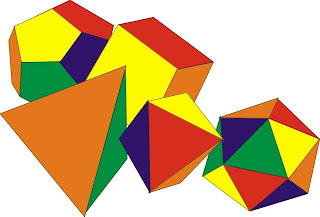 Playing with geometry, Constructions
Children played with straws, flat shapes, and blocks and built sculptures.
3D Animation
The origin of numbers, the 0, 1, the concept of binary numbers, the Fibonacci numbers, and the abacus.
The students of the school conducted the maths workshop, where there were different games based on mathematical concepts. Students from different schools visited the workshop in batches. The concepts that the mela focussed on were not direct applications of the curriculum, but more about mathematical “wonders”.
Unfortunately, photography was prohibited at the mela. These are some of the concepts that the exhibits were based on:
The Seven Bridges of Konigsberg
The Seven Bridges of Konigsberg is a notable historical problem in mathematics. Its negative resolution by Leonhard Euler in 1735 laid the foundations of graph theory and presaged the idea of topology. The problem was to find a walk through the city that would cross each bridge once and only once. The islands could not be reached by any route other than the bridges, and every bridge must have been crossed completely every time (one could not walk half way onto the bridge and then turn around and later cross the other half from the other side). Euler proved that the problem has no solution.
At the mela, there was a 3d model of this problem, and students were trying to make a toy car travel through as many bridges as possible. The concept was then explained to them.

Pick a number between 1 and 60. There are five boards with random numbers in a grid. The “magician” will guess the number on your mind by checking if it appears on any of the boards. The number on your mind is the sum of the first numbers on all the boards that your number appears on.
Ames Room
An Ames room is a distorted room that is used to create an optical illusion. An Ames room is constructed so that from the front it appears to be an ordinary cubic-shaped room, with a back wall and two side walls parallel to each other and perpendicular to the horizontally level floor and ceiling. However, this is a trick of perspective and the true shape of the room is trapezoidal. As a result of the optical illusion, a person standing in one corner appears to the observer to be a giant, while a person standing in the other corner appears to be a dwarf. The illusion is convincing enough that a person walking back and forth from the left corner to the right corner appears to grow or shrink. This is used in television, special effects, etc.
At the mela, there was a 3D exhibit which children could learn this phenomen from. Through a peephole, they could see the optical illusion created.

With the striker and the other coin at the two focus points of the ellipse, when the striker is hit at any point of the circumference of the ellipse, it definitely passes through the second focus point, that is, hits the other coin.

In geometry, a Platonic solid is a convex polyhedron that is regular, in the sense of a regular polygon. Specifically, the faces of a Platonic solid are congruent regular polygons, with the same number of faces meeting at each vertex; thus, all its edges are congruent, as are its vertices and angles.
There are precisely five Platonic solids: Cube, Tetrahedron, Octahedron, Dodecahedron and Icosahedron

Children played with straws, flat shapes, and blocks and built sculptures.
3D Animation
The origin of numbers, the 0, 1, the concept of binary numbers, the Fibonacci numbers, and the abacus.
Sunday, August 1, 2010
Reading: Designing Multimedia Environments for Children- Computers, Creativity and Kids


- An overview of the past, present and future trends in multimedia for children
- Compare the process, results, and impact of different multimedia approaches
- A framework to develop your own approaches to multimedia
- Origins of Educational Multimedia Environments: Kids today:When developing multimedia environments for children, we as designers must remember that children are not just short adults. We cannot water down multimedia environments designed for adults and expect them to be valuable environments for children. Young people have their own likes, dislikes curiosities, and needs that are not the same as their adults and parents. They love to draw, use clay, build with blocks, watch videos and play games. Children love repetition, but only when they are in control- Honesty, curiosity, repetition and control.
- Elementary school math design issues:Elementary school mathematics is an area which is constantly under scrutiny and attack. Since atleast the beginning of the 20th century, educators in the United States have tried to fix things in the math classroom. Yet, it seems the majority of the elementary teachers and students have remained alienated. Societal needs for people who are comfortable in mathematical thinking escalate while the gap widens. The reality and pervasiveness of computers in our lives creates new needs and new opportunities to look at mathematics education reform. As educators, designers of educational material, graphic designers, programmers, parents, teachers, or critics, we need to identify our own biases, learning theories, and educational strategies.
- Extending the curriculum: Math investigations:
The CCC (Computer Curriculum Corporation) math material first developed at Stanford in the mid-1960s is now part of the SuccessMaker system; it “is a technology-based learning system that helps teaching and administrators meet educational goals. State-of-the-art multimedia-including digitized sound, full-motion video, and animation-provide interactive learning experiences for students at all grade levels” (CCC 1993,2). Math Investigations is a response to the recommendations of the NCTM standards to teach problem-solving in elementary school math. So, CCC obtained the Math Processor, which contains “online math tools and manipulatives” such as dynamically linkable graph, spreadsheet, and chart generators, a geometric construction set with linear and angular measurement tools, and other such tools. Children are given problem-solving situations which require calculations of various sorts. - Discovery learning:
Davis is identified with a pedagogical approach called discovery learning or discovery teaching by which he means “that a teacher might call attention to a problem, but the task of inventing a method for dealing with the problem was left as the responsibility of the student” Discovery learning is one approach that teachers can use to help you build your internal structure and also help you correct this structure when it is wrong. - There are three types of multimedia authoring tools:
1. Multimedia resources: libraries of multimedia sound, images, video, and so forth
2. Multimedia presentations: tools to create slide shows, movies, animations
3. Multimedia interactive authoring: tools to create interactive nonlinear multimedia - The Visual Almanac, Kid Pix and HyperStudio are examples of different approaches to multimedia authoring for children
- While most authoring tools today emphasize the glue they give to combine different forms of media, the Visual Almanac emphasizes the types of media that can be glued together.
- Kid Pix Studio is a paint, animation, and slide show program with a distinct sense of humour that appeals to young children (and adults).
- HyperStudio is a multimedia authoring tool that a fourth grader could use to create a class project on whales or an interactive family tree with his or her grandmother at home.
- Such professional authoring tools as Macromedia’s Director and Apple Computer’s Apple Media Tool offers examples of powerful metaphors that can be incorporated into children’s environments for the future.
- Physical Multimedia Environments- The virtual versus the physical world:
- In the future, children’s multimedia environments may not have to live in hard plastic boxes that sit on desktops with keyboards, mice, or the occasional joystick.
- Multimedia environments in the future may look like any familiar room, stuffed animal, or toy block, and may be responsive to a child’s movement, touch, sound, or even gesture.
- By offering real-world objects and places enhanced with technologies, physical multimedia environments can offer more powerful and involving learning experiences for children.
- The Media Room, LEGO TC Logo, and Immersive Environments all have enormous potential for future physical multimedia environments for children.
- Designing physical multimedia environments that utilize the power of new technologies, media, and physical spaces invites the collaboration of diverse talents.
- Communication between technical and nontechnical, visual and non-visual designers may be the most challenging of the design process- PROTOTYPING is helpful.
- Thoughts about tomorrow: “The best way to predict the future, is to invent it”
- Some questions we can ponder about our future:
1. What will our future approaches to teaching and learning be?
2. What will our future technologies be?
3. Where will our future technologies be created?
4. What will not change in the future? - Social context
- With technologies similar to Virtual Reality, we will begin to see more and more information superimposed on our physical surroundings.
- As more and more of our information becomes digital, we will need better ways of organizing the huge quantities of text, graphic, and sound in our future.
- As we look towards the future, there are certain design principles that will not change:
1. Interdisciplinary team design
2. The importance of content design
3. Quality production values
4. The importance of choosing an educational approach (and understanding why you’ve chosen it)
- Some questions we can ponder about our future:


Friday, July 30, 2010
Mindmapping


Tuesday, July 27, 2010
Interviews
QUESTIONNAIRES

Teachers:
1. What are the teaching methodologies that differentiate your board (CBSE etc.) from the others?
2. How do your children enjoy the Math class?
3. How do they fare on Math tests (on an average)?
4. How much of workshop/practical learning sessions are incorporated within the curriculum? How do the students enjoy those sessions?
5. Do you think mathematics is better taught the traditional way, or do you encourage a more ‘learning through doing’ approach?
6. What are your views on ‘integrated curriculum’ and integrative learning?
7. Does your school spend money on new technologies for learning?
8. What are your views on technology, and how do you think it can be used to enhance learning? What in your opinion are the pros and cons of using technology and new media in education?
Students:
1. Do you like Math? If not, what do you not like?
2. How well do you score on Math tests?
3. Can you see Math in the world around you? Where?
4. Do you see purpose in the math skills you learn in school?
5. Do you play educational games? If so, which ones?
6. Would you be comfortable learning by yourself, through a game, or a book? Or would you need a teacher to instruct you?
7. Are you familiar with using the computer? Do you prefer playing games on the computer as opposed to reading a book?
8. If you were in charge of your class, how would you like to teach your 'students' math? What do you think is the best way for them to learn? Imagine your 'Dream Math Class'!
SCHOOLS
Delhi Public School (Bangalore North): (C.B.S.E) Std. 5 & Std. 6
(Smartclass is a digital initiative of Educomp, which is rapidly transforming the way teachers teach and students learn in schools with innovative and meaningful use of technology. Powered by the world’s largest repository of digital content mapped to Indian School Curriculum, smartclass brings in technology right next to the blackboard for teachers in the classrooms. Students learn difficult and abstract curriculum concepts watching highly engaging visuals and animations. This makes learning an enjoyable experience for students while improving their overall academic performance in school. Smartclass has a unique delivery model for schools. A knowledge center is created inside the school equipped with the entire library of smartclass digital content. The knowledge center is connected to the classrooms through Intranet. Teachers get the relevant digital resources such as animations and videos, interactive virtual labs tools etc. and use them as a part of their lesson plans in every classroom period.) 


Mallya Aditi International School: (I.C.S.E) Std. 4


Teachers:
1. What are the teaching methodologies that differentiate your board (CBSE etc.) from the others?
2. How do your children enjoy the Math class?
3. How do they fare on Math tests (on an average)?
4. How much of workshop/practical learning sessions are incorporated within the curriculum? How do the students enjoy those sessions?
5. Do you think mathematics is better taught the traditional way, or do you encourage a more ‘learning through doing’ approach?
6. What are your views on ‘integrated curriculum’ and integrative learning?
7. Does your school spend money on new technologies for learning?
8. What are your views on technology, and how do you think it can be used to enhance learning? What in your opinion are the pros and cons of using technology and new media in education?
Students:
1. Do you like Math? If not, what do you not like?
2. How well do you score on Math tests?
3. Can you see Math in the world around you? Where?
4. Do you see purpose in the math skills you learn in school?
5. Do you play educational games? If so, which ones?
6. Would you be comfortable learning by yourself, through a game, or a book? Or would you need a teacher to instruct you?
7. Are you familiar with using the computer? Do you prefer playing games on the computer as opposed to reading a book?
8. If you were in charge of your class, how would you like to teach your 'students' math? What do you think is the best way for them to learn? Imagine your 'Dream Math Class'!
SCHOOLS
Delhi Public School (Bangalore North): (C.B.S.E) Std. 5 & Std. 6
- Most children from this school were quite fond of the subject, though some of them found it hard to grasp. In terms of application, apart from ‘money’ and ‘school’, they weren’t able to relate mathematics to the world around them.
- The school organizes math labs once a week, where students work on group projects, class activities and games.
- Many students said they would be comfortable learning on their own, but would like some guidance from their teacher as well.
- They played educational games like “Math quiz”, “Scrabble”, “Think Fun”, and memory games.


Mallya Aditi International School: (I.C.S.E) Std. 4
- Most children seemed to enjoy their math classes. They play class games like “Around the world”, “Multiplication facts”.
- They were quite aware of the applications of math in the real world- They came up with answers like “Money”, “Time”, “Computers”, “Business” and “Stock Market”!
- They liked playing games on the computer more than reading books, and solved online puzzles and educational quizzes. They also solved Sudoku and crosswords.
- They wanted to play games like monopoly in class, and learn geometry by building 3D models, cutting shapes etc. “I want to learn Math only through quizzes. No tests and textbooks!”

Poorna Prajna Education Centre: (Karnataka State Board) Std. 4, Std. 5 & Std. 6
- Most students preferred reading books to playing games on the computer.
- The students preferred to have a teacher to guide them, rather than learning on their own through games and/or books. They also said that their ideal math class should be “stress free”, and the focus should be on fun and play, not on homework and tests.
- They play educational games like “Word Building” and crosswords. Some children said they see math in the world around them in “Money”, “Measurement” and “Counting”- “From the number of pens in my pencil box, to the population of my country”. Rest of them said they see math only on the blackboard and in school.
- Math teachers regularly attend workshops such as “Creative teaching”, “Classroom management”, “Evaluation techniques” held at the Poorna Prajna Institute of Faculty Improvement. The school is on its way to set up a Math Lab.
- Math teachers think that a “learning through doing” approach is appreciated by students, but some topics need to be taught the traditional way. They also think “integrative learning” depends highly on the motivation of the child and his/her aptitude to grasp concepts and draw connections.
- The teachers also think that technology should come with limitations- “Teachers and students are more important than technology. Especially when it comes to exams, I am sorry to say but drilling is a must, both at home and school.”

Friday, July 23, 2010
Flatland

Flatland: A Romance of Many Dimensions is a satirical novella by the English schoolmaster Edwin Abbott Abbott. Writing pseudonymously as "a square", Abbott uses the fictional two-dimensional world of Flatland to offer pointed observations on the social hierarchy of Victorian culture. However, the novella's more enduring contribution is its examination of dimensions. Noted science writer Isaac Asimov described Flatland as "The best introduction one can find into the manner of perceiving dimensions."
(The story is about a two-dimensional world referred to as Flatland which is occupied by geometric figures, line-segments (females) and regular polygons with various numbers of sides.The narrator is a humble Square, a member of the social caste of gentlemen and professionals in a society of geometric figures, who guides us through some of the implications of life in two dimensions.The narrator is then visited by a three-dimensional sphere, which he cannot comprehend until he sees Spaceland for himself.After the Square's mind is opened to new dimensions, he tries to convince the Sphere of the theoretical possibility of the existence of a fourth (and fifth, and sixth ...) spatial dimension.)
Thursday, July 22, 2010
Reading: Mindstorms
Children, Computers, and Powerful Ideas -Seymour Papert
Excerpts:
Excerpts:
- “Constructionism”- It differs from constructivism in that it “looks more closely...at the idea of mental construction.” The computer is seen by Papert as a powerful tool for supporting children’s learning- for learning in a self-directed, self-motivated way, in the course of programming. Rather than seeing the computer as a mechanism for instilling knowledge and skills via workbook like exercises, Papert’s programming language, LOGO, allows children to take control of the computer, learning about mathematics through the experience of mathematical concepts.
- In most contemporary educational situations where the children come into contact with computers it is usually the computer programming the child. In the LOGO environment, the role is reversed: The child, even at preschool ages, is in control: The child programs the computer. And in teaching the computer how to think, children embark on an exploration about how they themselves think. Thinking about thinking turns the child into an epistemologist.
- Our culture is very rich in materials useful for the child’s construction of certain components of numerical and logical thinking. Children learn to count; they learn that the result of counting is independent of order and special arrangement; they extend this “conversation” to thinking about the properties of liquids as they are poured and of solids which change their shape. Children develop these components of thinking pre-consciously and “spontaneously,” that is to say without deliberate teaching. Other components of knowledge, such as the skills involved n doing permutations and combinations, develop more slowly, or do not develop at all without formal schooling.
- Piaget distinguishes between “concrete” thinking and “formal” thinking. Concrete thinking is already well on its way by the time the child enters the first grade at age 6 and is consolidated in the following years. Formal thinking does not develop until the child is almost twice as old–The computer can concretize (and personalize) the formal.
- Many children are held back in their learning because they have a model of learning in which you either “got it” or “got it wrong.” But when you learn to program a computer you almost never get it right the first time.
- This potential influence of the computer on changing our notion of a black and white version of our successes and failures is an example of using the computer as an “object to think with.”
- Critics have pointed to the influence of the allegedly mechanized thought processes of computers on how people think. McLuhan’s dictum that “the medium is the message” might apply here: If the medium is an interactive system that takes in words and speaks back like a person, it is easy to get the message that machines are like people and that people are like machines. What this might do to the development of values and self-image in growing children is hard to assess.
- Ways to take educational advantage by mastering the art of deliberately thinking like a computer, for example, in a step-by-step, literal, mechanical fashion. Some children’s difficulties in learning formal subjects such as grammar or mathematics derive from their inability to see the point of such a style.
- By deliberately learning to imitate mechanical thinking, the learner becomes able to articulate what mechanical thinking is and what it is not. The exercise can lead to greater confidence about the ability to choose a cognitive style that suits the problem. “Style of thinking”
- The intellectual environments offered to children by today’s cultures are poor in opportunities to bring their thinking about thinking into the open, to learn to talk about it and test their ideas by externalizing them. Access to computers can dramatically change this situation.
- The computer is not a culture unto itself but it can serve to advance very different cultural and philosophical outlooks.
- The educator must be an anthropologist
Wednesday, July 21, 2010
Scratch

Scratch is developed by the Lifelong Kindergarten research group at the MIT Media Lab (http://llk.media.mit.edu). This is a fascinating software for children (or anyone else) to create, design and learn. With a very simple interface and instructions, it is easy to grasp. It allows children to play with characters, animation, sound, narrative and the concept of programming. I was introduced to this today, and have been experimenting ever since. Extremely addictive :)
Science in Art: A Perpetual Motion Machine
A moving sculpture by norwegian artist Mr. Reidar Finsrud. It appears to use a combination of gravity, magnets, and pendulum effects, which modern physics would say is impossible, to generate nearly continuous motion since 1996, when it was assembled.
(A steel ball (about 2.7 inch diameter, 20 pound) is rolling on an aluminum track, about 25 inches in diameter, placed horizontally. Three pendulums, about 45 inches long with tunable weights at the lower end, controls three horse-shoe magnets that the steel ball has to pass by on the track. Embedded in the track is a (mechanical) controlling/timing mechanism. It looks like a steel wire bent into a triangular track, 5 inches long. The ball rolls over it and pushes the wire down through a slot in the track. This affects one of the pendulums and regulates its swinging motion.)
Role-Playing Your Way to Math Mastery?
A massively multiplayer online game requiring players to employ mathematical concepts could revolutionize the teaching of mathematics at the middle school level, according to Stanford mathematician Keith Devlin.
Key points:
-The importance of 'context'
-Using mathematics to achieve goals, and to see the outcome of that immediately
-Video games help students overcome that period when they haven’t seen value in the mathematics they learn
-The one thing that is missing in a math class is the meaningful environment
Tuesday, July 20, 2010
Reading: The New Media Reader (Introduction)
Inventing the Medium -Janet H. Murray
Excerpts:
New Media from Borges to HTML -Lev Manovich
Excerpts:
Excerpts:
- Establishing the genealogy of the computer as an expressive medium
- Bush and Borges-Failure of the linear media to capture our structure of thought
- Reflecting not a new technology, but a change in how our minds are working
- We see the scientific culture articulating a medium that “augments” our humanity, that makes us smarter by pooling our thinking and organizing it at a higher level, and even by facilitating new ways of thinking that are more synthetic and have more power to master complex operations and ideas.
- Englebart did not think of the computer as merely improving human thinking, but as transforming the processes of our institutions in a more profound way.
- A decade before the development of “multimedia” and at the point when “hypertext” was just a concept, the sheer representational power of the computer was apparent to those who were leading its development. They realized that the whole of the medium was much more than the sum of the various enabling technologies.
- The awe-inspiring representational power of the computer derives from its four defining qualities: its procedural, participatory, encyclopaedic, and spatial properties.
- The more fundamental properties, the procedural and participatory foundation of the computer, are the ones that provide the basis for what we think of as the defining experience of the digital medium, its “interactivity.” Although this word is often used loosely it can be thought of as encompassing these two properties, and also the pleasure of agency, the sense of participating in a world that responds coherently to our participation.
- The critics of technology are an important part of the development of a new medium because they challenge us to identify more clearly what we find so compelling about it, why we are so drawn to shape this new clay into objects that haven’t existed before.
- The videogame also won over the young to the new medium and developed an expanding vocabulary of engagement, including ever more detailed and intricate elaboration on the theme of the violent contest as well as increasing interest in creating detailed, immersive, expressive story worlds.
- Sherry Turkle offered the foundational view of the psychosocial dynamics of the digital medium, calling it a “second self” upon which we projected consciousness, and an “evocative object” which had tremendous “holding power” over the interactor.
- We are drawn to a new medium of representation because we are pattern makers who are thinking beyond our old tools. We are drawn to this medium because we need it to understand the world and our place in it.
New Media from Borges to HTML -Lev Manovich
Excerpts:
- The logic of the art world and the logic of new media are exact opposites. The first is based on the romantic idea of authorship which assumes a single author, the notion of a one-of-a-kind art object, and the control over the distribution of such objects which takes place through a set of exclusive places: galleries, museums, auctions. The second privileges the existence of potentially numerous copies; infinitely many different states of the same work; author-user symbiosis (the user can change the work through interactivity); the collective; collaborative authorship; and network distribution (which bypasses the art system distribution channels).
- As digital and network media rapidly become an omnipresent in our society, and as most artists came to routinely use this new media, the field is facing a danger of becoming a ghetto whose participants would be united by their fetishism of latest computer technology, rather than by any deeper conceptual, ideological or aesthetic issues.
- In the last few decades of the twentieth century, modern computing and network technology materialized certain key projects of modern art developed approximately at the same time. In the process of this materialization, the technologies overtook art. That is, not only have new media technologies actualized the ideas behind projects by artists, they have also extended them much further than the artist originally imagined.
- New Media vs. Cyberculture: Cyberculture is focused on the social and the networking; new media is focused on the cultural and computing.
- New Media as Computer technology used as a distribution platform
- New Media as Digital Data Controlled by Software
- New Media as the Mix between Existing cultural conventions and the conventions of software
- New Media as the aesthetics that accompanies the early stage of every new modern media and communication technology
- New Media as faster execution of algorithms previously executed manually or through other technologies.
- New Media as the encoding of modernist Avant-Garde; New Media as Metamedia.
- New Media as parallel articulation of similar ideas in post-ww2 art and modern computing.
Children's Number books at the M.A.I.S Junior Library


Simple narrative style
Questioning and Problem solving through storytelling
Colourful and friendly illustrations
Basic interactivity (Counting beads)
Bold use of type
Ko's Journey: An online story-based math adventure
Ko's Journey is a first of its kind web-based application designed to teach the core concepts of middle school math through storytelling. Paced for learning and comprehension, it provides more depth and context than most math games.
http://www.kosjourney.com
http://imagineeducation.org
Subscribe to:
Posts (Atom)